
Sell the hat the way you make it.
Catalena Hatters makes about 4,000 hats a year by hand and sells them through a website that reads like a catalog. We spent a day inside catalenahatters.com, read the reviews, priced twenty-three competitors, and rebuilt the homepage from the shop's own visual language. This page is the front door to everything we found and everything we propose.
- Prepared
- 6 September 2026
- Store studied
- catalenahatters.com
- Documents
- Six, each in a new tab
- Evidence
- 33 screenshots, 44 sources, 211 products
- Status
- For the shop's review
Six documents, in reading order
Each one opens in a new tab, so this page stays where you left it. Start at the top, or jump straight to the one you need.
-
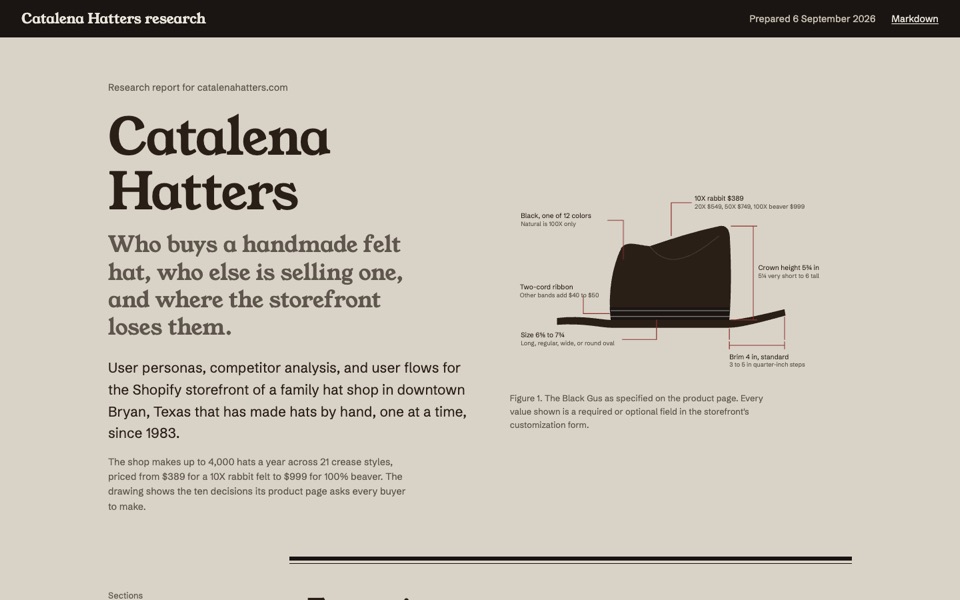
Who buys a handmade felt hat, who else is selling one, and where the storefront loses them. Personas drawn from reviews and press, a four-ring competitor map, and every buying flow as it works today and as it should.
-
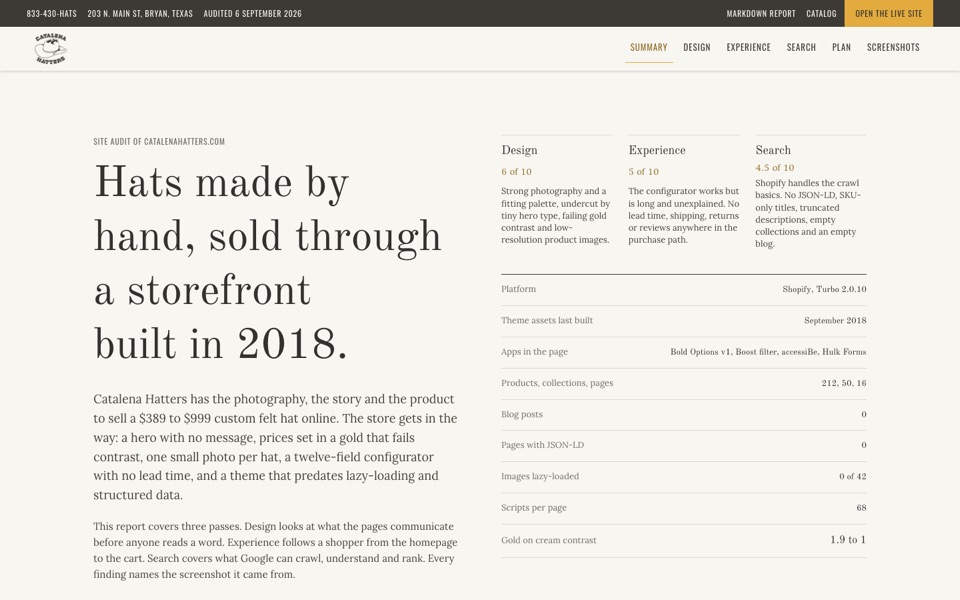
The live store, page by page, with the evidence beside each finding: what works, what fails, and what to fix this month before any redesign ships. Scored, ranked and measured in the browser.
-
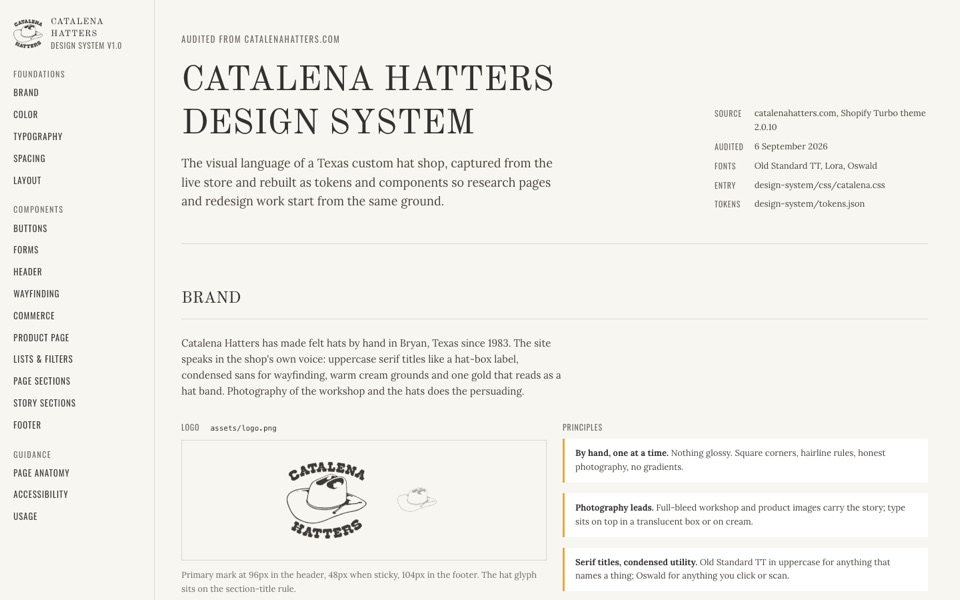
The store's own visual language, measured from the live theme and rebuilt as tokens and components, so every page in this proposal starts from the same ground. It keeps the cream, the serif and the gold, and adds a contrast mode that makes the gold readable.
-
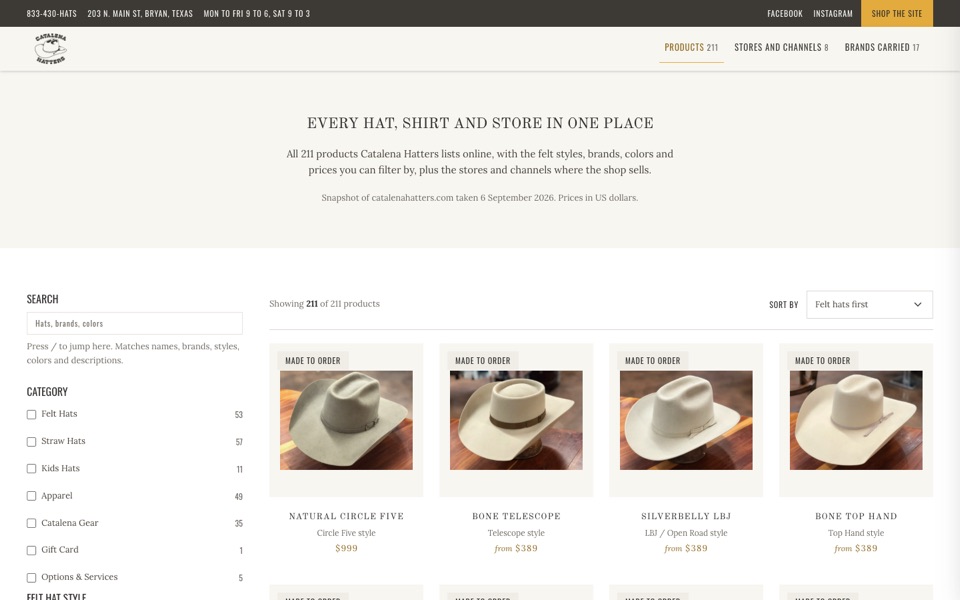
Everything the shop sells online in one searchable page, with the stores and channels it sells through and the brands it carries. Filters live in the address bar, so a view can be shared. Prices in US dollars as listed on 6 September 2026.
-
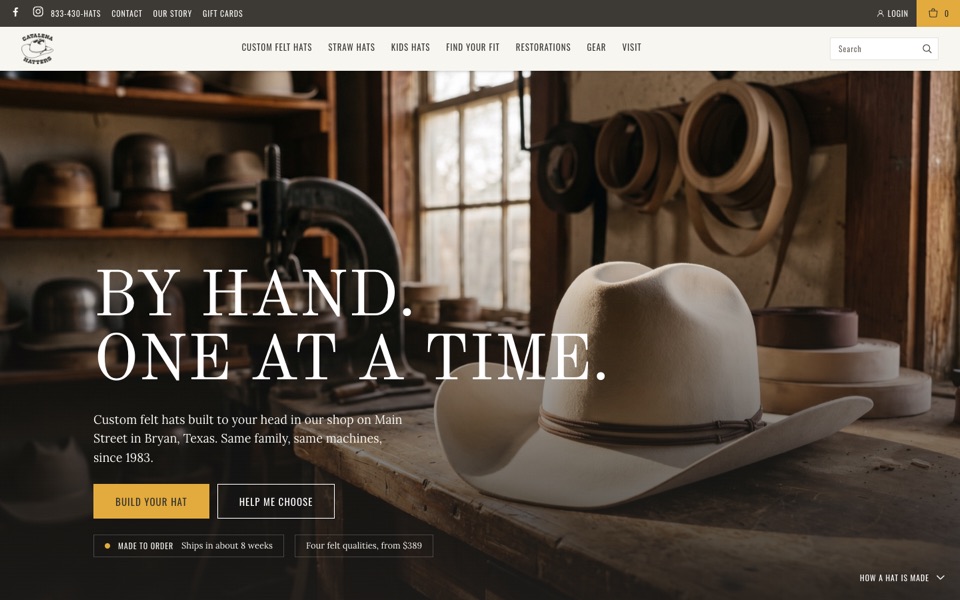
A working page, not a picture of one. The making of one hat in five chapters on a sticky image stage, then five doors for five kinds of customer, the twenty-one styles, proof from the reviews, restoration and the shop itself. Built entirely from the design system.
-
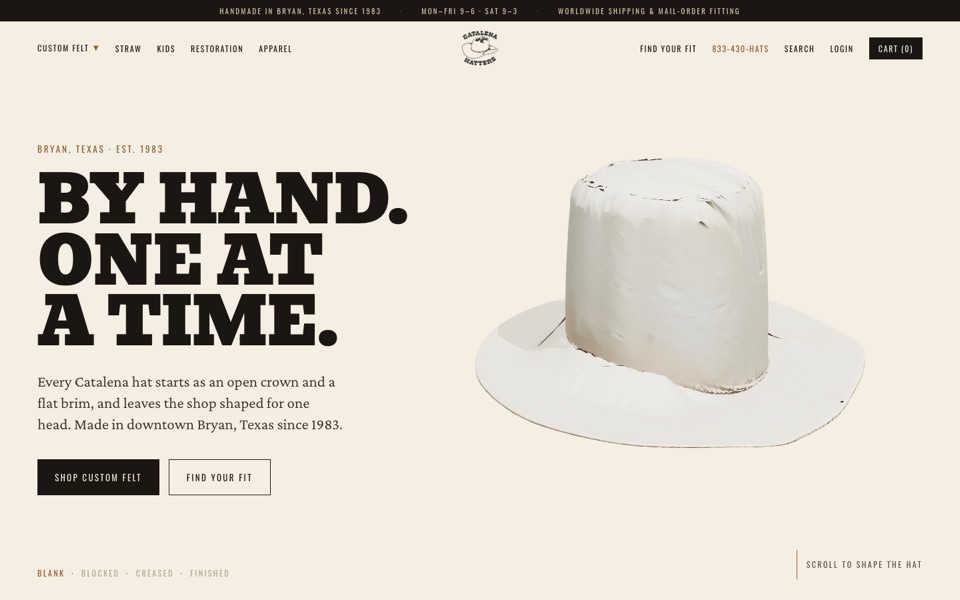
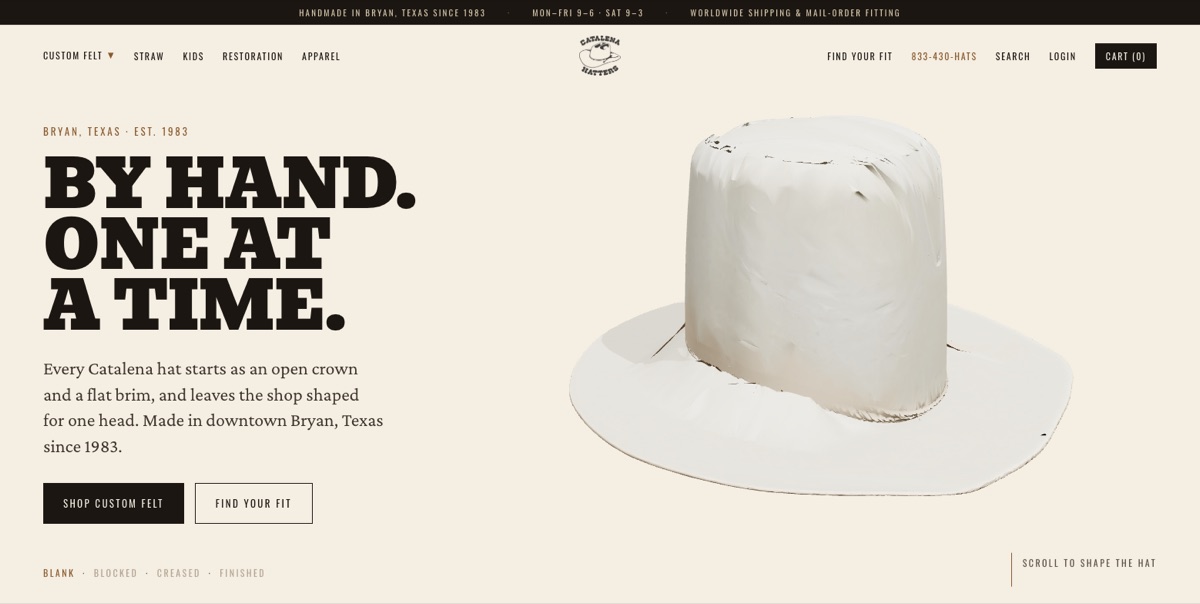
The same homepage taken further. The hat is drawn in the browser rather than photographed, and it shapes itself from open crown to finished Gus as the first screen scrolls. 1983 is told in three chapters, the twenty-one crowns sit in one wall, and the straw makers are named. It leaves the design system behind on purpose, so read it beside version 1, not instead of it.
What we found
The site is a catalog, not a guided experience. The craft, the prices and the reputation are all there; the trust around them is not. Six findings drive everything else.
-
Nothing tells the buyer when, how, or on what terms the hat arrives.
A made-to-order hat at $389 to $999 with no production time on the product page, in the cart or in the confirmation email. The FAQ is empty and the shipping policy returns a 404. This is the single biggest conversion leak on the site.
In the audit: priorities (opens in a new tab) -
The brand gold fails contrast everywhere it is used.
Gold on cream measures 1.9 to 1 and white on the gold button 2.1 to 1. Prices, links, breadcrumbs and Add to cart all fall below the accessibility floor. The design system fixes this with a darker gold for small text and ink on the buttons, without changing the brand.
In the audit: finding D3 (opens in a new tab) -
The custom hat form puts the whole burden of expertise on the buyer.
Ten fields, fractions of an inch, a head oval shape, and no explanation of what 10X means or why 20X costs $160 more. Everyone who walks into the shop gets that explained by a person. The website leaves them alone with it.
In the audit: the product page (opens in a new tab) -
Restoration, the rarest thing the shop does, happens entirely by mail.
Customers are asked to post the hat with a check or a credit card number written down, then wait four to six months with no status. The one sharp negative review is about exactly this.
In the research: user flows (opens in a new tab) -
Two hat bars opened within walking distance.
Cowgirl Up is across Main Street at 212. Brazos Brim holds the Texas A&M licence. They sell a 45-minute memory for $150 to $400, ready the same day, and they win the first-hat buyer on speed and fun. The counter is not to become one; it is to make the real thing bookable and visible.
In the research: the competitive rings (opens in a new tab) -
The entry price beats every serious bespoke hatter by $300 to $500, and nobody says so.
Greeley starts at $913. JW Brooks tops out at $1,375. Catalena's 100% beaver is $999 and its 10X is $389. The advantage is real and under-communicated; the trust scaffolding around it, lead times, deposits, appointments, is what the others publish and Catalena does not.
In the research: competitor analysis (opens in a new tab)
What we propose
Four moves on the homepage, one foundation under every page, and a short list of fixes for the store as it stands. The homepage is built and linked above; the moves are what it does differently.
-
Give the brand line the top slot.
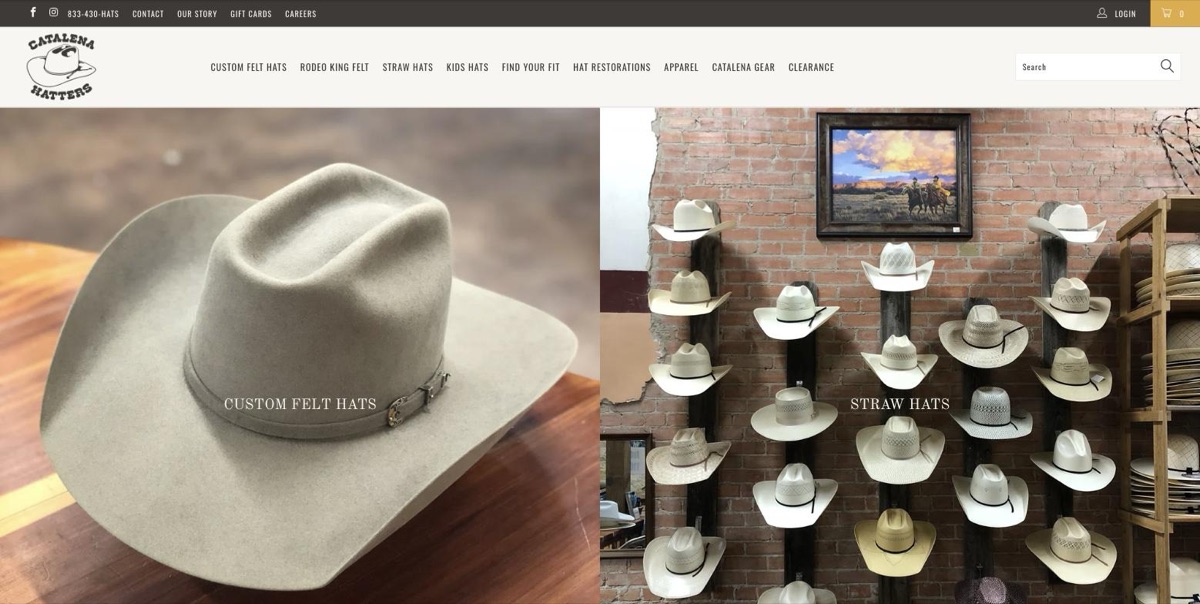
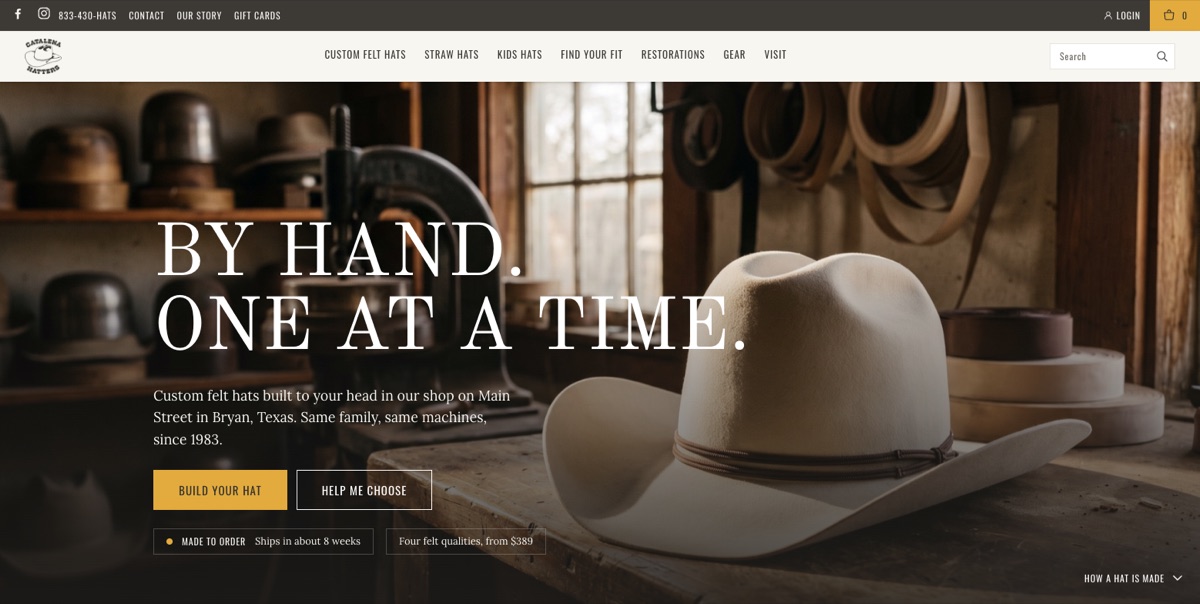
“By hand. One at a time.” becomes the headline, with a lead time, the price floor and two actions above the fold. The two promo tiles go. Desktop finally gets the headline and button that mobile already had.
-
Tell the making of one hat before showing twelve of them.
Five chapters on a sticky image stage: body, block, crease, trim, yours. The four felt grades and their real prices, $389 to $999, are explained in plain words inside the story, so the buyer arrives at the form already knowing what 20X means.
-
Open five doors instead of one grid.
I know my style. Help me choose. It's a gift. Bring an old hat back. I just need a straw for summer. One ruled row per kind of customer, each leading to the right page, so the person who does not know their head size is never sent to ten dropdowns first.
-
Bring restoration and fittings online.
A photo-first restoration intake with a written scope and a deposit, and a call within two business days to confirm every custom order before it is blocked. These are the target flows from the research, and they are marked on the page as proposals for the shop to confirm.
Under all of it, the design system.
Every color, type size and spacing step was measured from the live theme and written down as a token. Every band on the redesigned homepage is a component in the style guide. That means the next page, a collection, a product page, a restoration form, starts from the same ground and looks like it belongs to the same shop. The style guide (opens in a new tab) is the reference; the homepage (opens in a new tab) is the proof.
Version 2: the hat story
Version 1 is the buildable one: every band in it is a component in the style guide, and the shop could ship it a section at a time. Version 2 asks a different question. If the thing being sold is a hat made by hand, what happens when the hat itself does the talking? Same shop, same facts, a page that goes further than the system allows.
Before it could ship
- The opening runs about four screens of sticky scroll, so three of its four chapters are unreachable without scrolling. It needs a reduced-motion and a no-JavaScript path first.
- The wall of crown styles reveals its photography on hover, which puts it out of reach by touch and by keyboard.
- No lead time appears anywhere on the page, and the research makes that the first thing above the fold.
- It does not build on the design system. Its palette and type are its own, so nothing in it carries to the next page for free.
- Open it from a served folder rather than a double-clicked file: it loads its own runtime and a 3D module from the network.
-
The hat is the hero, and it shapes itself.
A felt hat is drawn in the browser and morphs from an open crown and a flat brim into a shaped Gus as the first screen scrolls. Blank, blocked, creased, finished: the four words of the making run under it as a progress track. It is the brand line, “by hand, one at a time,” demonstrated rather than claimed.
-
Its own palette and type, and the contrast problem solved differently.
Cream, ink, sand and a saddle brown that measures 5.5 to 1 on the cream, so the accent passes AA as text. The brand gold that fails contrast on every page today never appears at all, and the body copy is set well above the live theme's 22-pixel ceiling. It is a bolder answer to the same audit findings.
-
1983 told in three chapters.
A magazine ad, then one condition, custom work only and never sell out, then the same floor on Main Street today. Family owned and operated since 1983 stops being a line in the footer and becomes the middle of the page.
-
Twenty-one crowns in one wall, and the straw makers by name.
Cattleman, Open Road, Telescope and the rest in a single list priced from $389, with the Gus given a feature of its own, the eight straw brands the shop carries and fits shown as logos, and restoration, the fit guide and the shop's hours all on the same page.
Both directions say the same things about the shop; they disagree about how loud to say them. Version 1 is ready to build on the system and safe to ship in pieces. Version 2 is the argument for spending more on the first screen. Tell us which one to build on, and the six fixes below apply either way.
Six fixes for this month
From the audit's action plan. Each is a theme or content change the shop can make on the current store now, before any redesign ships, and each closes a leak the findings above describe.
The full plan: quick wins, next quarter, long term (opens in a new tab)
Put lead time, shipping and returns on the product page and in the cart.
A trust block: production time, shipping, returns, handmade in Bryan, Texas, and the phone number.
Fix the gold contrast.
Theme CSS only. Darker gold for small text, ink on the buttons. The brand keeps its color.
Give the desktop hero a headline and a call to action.
Done in the theme editor. Mobile already has both; desktop shows two photos and 22-pixel labels.
Fix the currency bug on option surcharges and search.
Add-ons show unconverted next to a converted base price; search shows a dollar figure with a peso sign. Verify in a US session.
Stop asking for a credit card number by mail.
Replace it on the restorations page with a deposit product or an invoice, and a photo upload.
Add structured data.
Product and Offer, BreadcrumbList, Organization and LocalBusiness, so hats show price and availability in Google. None exists today.
Who the site has to work for
Six people, drawn from the reviews, the press, the catalog and the competition. Names are illustrative; the needs are not. Every door on the redesigned homepage answers one of them.
-
Travis
The working cowboy
Wears a hat 300 days a year, reorders the same spec every few years and drives hours to the shop. Needs a stated lead time, a phone number everywhere, and restoration he can start online.
-
Kaylee
The rodeo family
Buys several hats a year including kids' sizes and shops on a phone at the arena. Needs a need-by date, a rush option, and photo shaping made obvious on straw hats.
-
Amy
The heritage gift-giver
Knows his size from his old hat, not what 20X means. Needs a gift path where whoever wears it confirms the details later, and restoration she can pay for without mailing a check.
-
Colton
The Aggie buying a first custom hat
$389 is a big spend, and the hat bar across the street is ready today. Needs the grades in plain language, installments, and a fitting he can book.
-
Jordan
The cowboy-core newcomer
Came through Yellowstone or a Texas wedding and wants the real thing, with a story. Needs help measuring, photos of the hat on a person, and clear shipping and returns.
-
Robert
The collector
Owns vintage Stetsons worth thousands and reads every word. Needs a written restoration scope, a deposit, status updates, and the fur content of every grade.
All six in full, with two secondary personas (opens in a new tab)
What we need from the shop
Three facts in the redesign are proposals until you confirm them, and one thing only you can supply.
- The real lead time for a custom felt hat
- The homepage says “ships in about 8 weeks” as a placeholder. It is the one fact the research says must be above the fold, and it should be yours.
- The call-back promise
- “We call within two business days to confirm every spec” describes the flow we recommend, not the current process. Keep it, change the window, or drop it.
- Online restoration intake and a gift path
- Both are recommendations from the research, shown on the homepage as doors. They need a form and a deposit behind them before they go live.
- Photography
- The hero, chapter and restoration photographs on the redesigned homepage are AI-generated stand-ins. The shop's own workshop and product photography replaces them before anything ships.
If you read one thing, open the homepage. If you read two, follow it with the research, which explains why every band is there. The audit is for whoever maintains the store this month.